Blog · Funnels & Landing Pages
The One-Page Funnel That Replaces Your Salon Website
Salon websites leak ad traffic. A one-page funnel converts 2–3x better. Here's the exact 7-section structure we use to turn clicks into booked appointments.
The One-Page Funnel That Replaces Your Salon Website
Your website has an About page, a gallery, a team page, a blog from 2021, and a navigation menu with nine choices. Your ad traffic needs exactly one choice.
I don't cut hair. I run ads and build funnels for salons, and the single highest-leverage change we make for most clients is this: we stop sending paid traffic to their website and send it to a one-page funnel instead. The median landing page converts at 6.6% across industries, and focused single-offer pages regularly exceed 10% [1] — while the average salon website converts ad clicks at 2–4%. Same click, same cost, two to three times the bookings.
Here's why the difference is so large, and the exact page structure we use.
Why websites leak paid traffic
A website is built for browsing. It assumes visitors arrive with different goals — checking prices, finding your hours, looking at your team — so it offers many paths. That's fine for someone who typed your salon's name into Google.
Ad traffic is different. Someone clicked because a specific offer caught their eye. When they land on a homepage with nine menu items, you've broken the promise of the ad and introduced nine ways to leave. Every navigation link is an exit. Every extra page is a leak. The full comparison is in landing page vs. website: where salon ad traffic should go.
A funnel page does the opposite: one offer, one page, one action.
The 7-section one-page funnel (top to bottom)
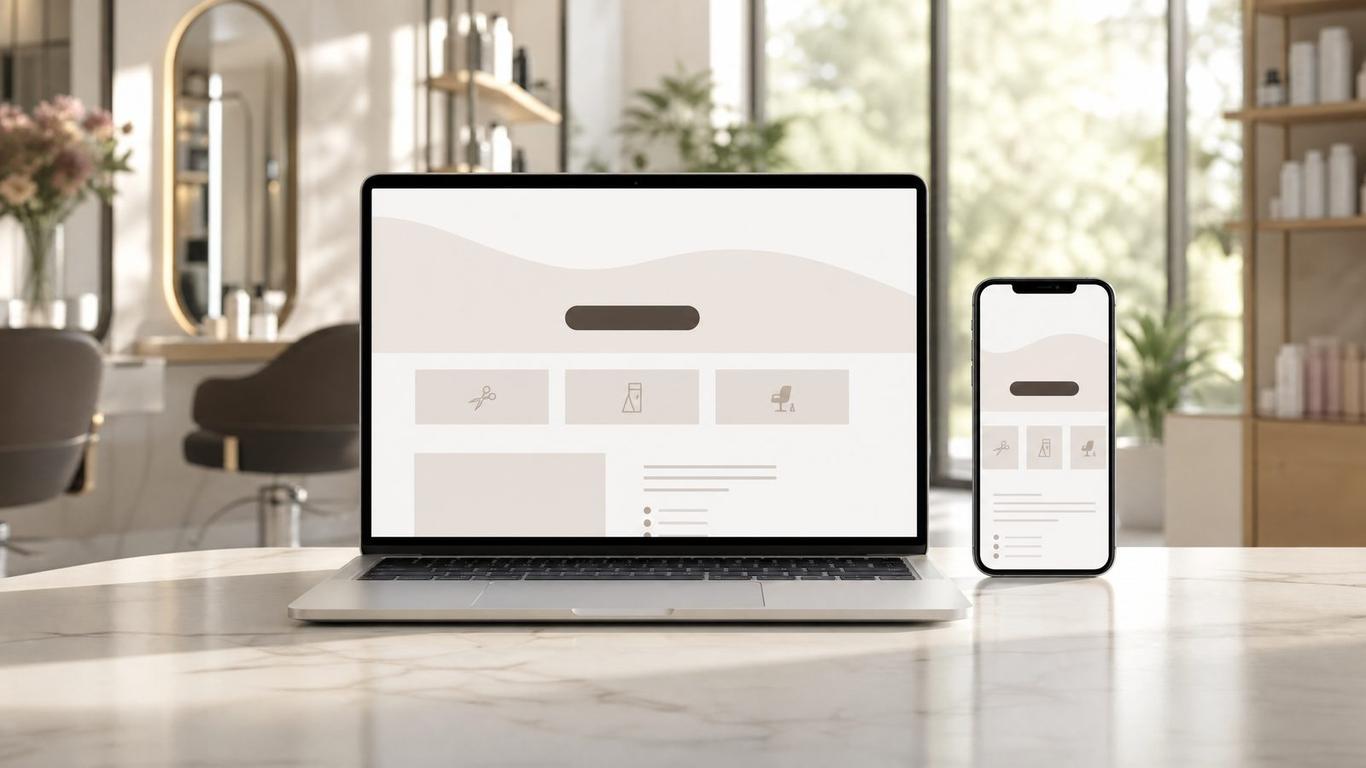
This is the structure we build for salons, in order. You can build it in any landing page tool in an afternoon.
Section 1: The hero — offer, proof, button
One headline naming the outcome ("Lived-In Blonde, Zero Brass — First Visit $129"), one line of proof ("4.9 stars from 300+ local clients"), one button ("Check Availability"). On a phone, all three must be visible without scrolling. If the offer isn't instantly clear, nothing below it matters.
Section 2: The transformation gallery
Four to six real before/afters of the specific service being offered — not a generic gallery. This is the section visitors spend the most time on, and it's doing the selling.
Section 3: How it works (three steps)
"Book your visit → Get your consultation → Leave with the hair you actually wanted." Three steps, one line each. This lowers the perceived effort of booking.
Section 4: Social proof
Three to five reviews that mention the specific service or stylist — pulled from Google, with names. Placement matters as much as content; see where reviews go on a page so they actually convert.
Section 5: Meet the stylist
One photo, three sentences. People book people, and a face with a name outperforms a faceless brand every time.
Section 6: The FAQ strip
Answer the four objections that stop bookings: price transparency ("what if it costs more?"), timing ("how long does it take?"), parking/location, and what happens if they don't love it. Each answer is one or two sentences.
Section 7: The final call to action with honest urgency
Repeat the offer and button, add real scarcity ("We take 12 new color clients a month"), and you're done. No footer menu. No links to your blog. One way forward.
What this does to the math
| Website (typical) | One-page funnel | |
|---|---|---|
| Conversion of ad clicks | 2–4% | 8–12% |
| 500 clicks → inquiries | 10–20 | 40–60 |
| Cost per lead at $2/click | $50–$100 | $17–$25 |
The ad spend is identical. The page is the entire difference. And because the funnel page has one job, it's also far easier to test and improve — split testing a salon landing page properly shows how.
"But don't I still need a website?"
Yes — for organic search, for existing clients, for credibility when someone looks you up. The funnel doesn't replace your website for those jobs; it replaces it as the destination for paid traffic. Your website is your home base for people already looking for you (website or Instagram: which should be a salon's home base); the funnel is the machine that turns ad clicks into bookings. Run both, each doing the job it's built for.
Quick reference: the one-page funnel checklist
- Offer + proof + button visible without scrolling on mobile
- Before/after gallery specific to the advertised service
- Three-step "how it works"
- 3–5 service-specific reviews
- Stylist photo and name
- Four-objection FAQ strip
- Final CTA with honest capacity limit
- Zero navigation menu, zero external links
- Loads in under 3 seconds on a phone (why mobile visitors bounce in four seconds)
FAQ
Does a salon need a website if it has a funnel page?
Yes. The funnel page converts paid traffic; the website serves organic search, existing clients, and credibility checks. They do different jobs — send ad clicks to the funnel and let the website handle everything else.
What should a salon landing page include?
Seven sections in order: hero with offer and button, service-specific before/afters, a three-step how-it-works, reviews, a stylist intro, a short objection-handling FAQ, and a final call to action with real urgency. No navigation menu.
What conversion rate should a salon funnel page get?
Target 8–12% of ad clicks converting to inquiries or bookings. The cross-industry median is 6.6% [1], and salon offer pages with strong before/after proof routinely beat it.
Can I build a salon funnel without a developer?
Yes — any modern landing page builder handles this structure with templates. The strategy matters more than the tool: one offer, one page, one action.
Want the map?
Download the free Salon Funnel Map — the seven sections laid out as a fill-in-the-blank wireframe, with the copy prompts we hand to clients.
Or book a free 20-minute marketing audit and we'll review your current page and tell you the one section that's costing you the most bookings.
References
[1] Unbounce — Average Landing Page Conversion Rates (Q4 2024)
Want this handled for you?
Ads, a booking-ready website, and AI follow-up for your salon — $297/mo, flat. Book a free 20-minute marketing audit and we'll walk through your exact numbers.
Book a free audit